
Your cactus is going soft at the base, developing yellow patches, and leaning to one side, and you are still watering it twice a week because you assumed a warm sunny position meant more water. That assumption is what kills the majority of indoor cacti, because a cactus that is softening and discolouring is seldom thirsty. This complete guide to cactus watering gives you the correct frequency for every situation, a simple diagnostic system, and the single framework that produces long-lived, healthy cacti: soak deeply, then wait until the soil is completely dry before watering again.
Most indoor desert cacti need watering every 2–4 weeks in spring and summer and every 4–8 weeks in fall and winter. Water deeply until it drains from the bottom, then let the soil dry completely throughout the pot before the next watering. When in doubt, wait two more weeks.
- Desert cacti and jungle cacti need completely different watering schedules: treating them the same kills one of them
- Overwatering kills far more cacti than drought; a cactus can survive weeks without water, but cannot survive weeks of waterlogged roots
- Pot type and soil determine how fast moisture leaves the root zone: both matter as much as how often you water
Skip to Section
How Often Should I Water a Cactus?
No fixed number of days applies to every cactus in every home. The correct frequency depends on the type of cactus, whether it is indoors or outdoors, the season, the pot material, the light level, and the size of the pot. The soil is the definitive check before every watering.
Before using the frequency table, identify which type of cactus you have:
Desert cacti: spiny, often globular or columnar, native to arid desert regions: barrel cactus, prickly pear, pincushion, saguaro, Opuntia, Mammillaria, Cereus, Echinocactus. These need the soil to be completely dry throughout before every watering. They are what most people picture when they think of a cactus.
Jungle or forest cacti: flattened, leaf-like stems, no true spines, native to tropical forest environments: Christmas cactus (Schlumbergera), Easter cactus, Thanksgiving cactus, night-blooming cereus. These need more moisture than desert cacti: the top half of the soil should dry between waterings, but they should not go completely bone dry.
University of Minnesota Extension states that most cacti need less water than other succulents and must be grown in pots with drainage holes, because excess water trapped in the soil results in rotting and decay in a very short time, and that when watering does occur, it should be done thoroughly.
This table serves one decision: which watering frequency range to start with for your cactus type and situation.
| Cactus type and location | Spring / Summer | Fall / Winter |
| Desert cactus: indoors, standard light | Every 14–21 days | Every 4–6 weeks |
| Desert cactus: indoors, bright sunny window | Every 10–14 days | Every 4–5 weeks |
| Desert cactus: indoors, low light | Every 21–28 days | Every 6–8 weeks or less |
| Mini cactus: indoors (pot under 10cm) | Every 10–14 days | Every 3–5 weeks |
| Desert cactus: outdoors, full sun | Every 7–14 days | Every 3–4 weeks |
| Desert cactus: outdoors, partial shade | Every 14–21 days | Every 4–6 weeks |
| Jungle cactus (Christmas, Easter cactus) | Every 7–14 days | Every 2–4 weeks |
| Terracotta pot | Check sooner: dries 30–50% faster | Adjust accordingly |
| Plastic or glazed pot | Check later: retains moisture longer | Adjust accordingly |
The soil test overrides every figure in this table.
Does a cactus need water every day?
No. Daily watering of a desert cactus causes root rot within weeks. Even outdoor cacti in peak summer heat rarely need more than weekly watering. Most indoor desert cacti need watering no more than twice per month in summer, and once or less per month in winter. Jungle cacti need water more regularly but still never daily: every 7–10 days in summer is appropriate.
How Much Water Does a Cactus Need?
The correct volume is sufficient to thoroughly wet the entire root zone in a single session. You are not aiming for a specific number of milliliters: you are aiming for water to flow freely from the drainage holes, confirming that the full root zone has been reached.
This table serves one decision: an approximate starting volume based on pot size.
| Pot size | Volume per session |
| Mini: under 9cm | 50–80ml (approx. 3 tbsp) |
| Small: 9–11cm | 80–120ml (approx. ¼ cup) |
| Medium: 12–15cm | 150–200ml (approx. ½–¾ cup) |
| Large: 16–20cm | 200–350ml (approx. ¾–1 cup) |
| Extra large: 21cm+ | 350–500ml+ |
These volumes apply to a well-draining cactus mix. Heavier mixes retain more and may require slightly less to reach saturation. Watch for drainage as the confirmation: volume is a guide, drainage is the proof.
How often to water a small cactus vs a large one:
Small cacti in mini pots dry out faster because the soil volume is limited. A cactus in a 7cm pot may need checking every 7–10 days in summer. The same species in a 20cm pot may only need checking every 14–21 days. Pot size is one of the strongest predictors of drying speed: check smaller pots more frequently.
What Is the Best Way to Water a Cactus?

The soak and dry method: the only method that works long-term
Cacti evolved for intense desert rainfall events followed by long dry periods. Mimicking this cycle (water deeply once, then wait for complete dryness) is the framework that keeps cacti healthy for years.
Clemson University Extension states that the cactus plant must never be permitted to stand in water, as waterlogged soil quickly leads to rotting of the roots, and that root and stem rots result from a soil mix that does not drain quickly or from overly frequent watering.
Step 1. Confirm the soil is completely dry throughout using the skewer test: push a dry chopstick all the way to the bottom of the pot. If any soil clings to the wood, the root zone still has moisture. Only a clean, dry skewer means the cactus is ready.
Step 2. Take the pot to the sink.
Step 3. Pour water slowly over the soil surface, directed away from the cactus stem. Never pour water onto the spines, stem, or crown.
Step 4. Continue until water runs freely from every drainage hole and every part of the soil has been reached.
Step 5. Allow to drain in the sink for 10–15 minutes. Do not rush.
Step 6. Empty the saucer. A cactus must never sit in standing water, even for 20 minutes.
Step 7. Return to its position only once draining has stopped.
Step 8. Do not water again until the full-depth skewer test confirms bone-dry soil.
Do you water cactus from the top or the bottom?
Top watering is the correct primary method for cacti. It delivers water through the full root zone and flushes mineral salt buildup from the soil with each session.
Bottom watering (placing the pot in a bowl of water) should only be used as a rescue method when the soil has become completely hydrophobic (water-repelling), running straight through without absorbing. In that case, submerge the base of the pot in a bowl of water for 15–20 minutes to rehydrate the soil from below, then drain fully and return to top watering.
Do not bottom water cacti routinely. It can keep the lower root zone damp while the surface appears dry, masking the actual soil moisture level and making overwatering harder to detect.
<!– SVG 1: Step-by-Step Process Diagram, Cactus Watering Method –>
Desert Cacti vs Jungle Cacti: Two Types, Two Different Rules

The most common source of confusion in cactus watering guides is treating all cacti as a single category. Two types with completely different watering needs sit on the shelves of the same garden center.
Desert cacti (the category most people mean when they say “cactus”) evolved in hot, arid environments where rainfall is seasonal and irregular. Between rainfall events, the soil is completely dry for weeks or months. Their thick stems and often spiny surfaces minimize water loss. They require soil to be bone dry throughout before every watering.
Jungle or forest cacti (Christmas cactus (Schlumbergera), Easter cactus, and Thanksgiving cactus) evolved as epiphytes in humid South American tropical forests, growing on tree branches and forest floors. They need more consistent moisture than desert cacti and should not be allowed to go fully dry. They also need a distinct cool, dry rest period in fall to trigger flowering.
This table serves one decision: which watering approach to apply to your cactus type.
| Feature | Desert cactus | Jungle cactus |
| Examples | Mammillaria, barrel, prickly pear, Cereus | Christmas cactus, Easter cactus |
| Native habitat | Hot, arid desert | Humid tropical forest |
| Soil rule | Completely dry throughout before watering | Top half dry, not bone dry |
| Summer frequency | Every 10–21 days | Every 7–14 days |
| Winter frequency | Monthly or less | Every 2–4 weeks |
| Water demand | Very low | Moderate |
| Main risk | Overwatering | Overwatering or bud blast from cold water |
Confusing these two types is the most common reason watering guides give conflicting advice. If someone asks “how often to water a cactus” and the answer is “once a week”, they are describing a jungle cactus. If the answer is “once a month in winter”, they mean a desert cactus.
How Often to Water Cactus Indoors?
Indoor cacti face specific challenges: limited light, no wind, no natural rainfall to calibrate the cycle, and (in winter) very low humidity that dries the air around the plant without drying the soil as fast.
The most important indoor cactus watering rule: always test the soil before responding to how the cactus looks. Unlike ferns or peace lilies, cacti do not show clear drought signals until they have been dry for a very long time. You cannot read thirst from a cactus’s appearance reliably.
NC State Extension confirms that cactus soil should be allowed to dry out completely between waterings, and that watering should be reduced even further during the winter dormant period.
How often to water mini cactus indoors?
Mini cacti in small pots (under 10cm) dry out faster than large specimens because the soil volume is smaller. In summer near a bright window, a mini cactus may need the skewer test every 7–10 days. In winter, every 3–5 weeks.
The key distinction: “checking” more often does not mean “watering” more often. Run the skewer test more frequently for small pots, but only water when the test confirms complete dryness.
Watering frequency by light level:
Light drives growth and water consumption. A cactus on a south-facing windowsill in full summer sun uses water significantly faster than the same cactus in a dim position.
- Bright, direct sunlight: check every 10–14 days in summer
- Bright, indirect light: check every 14–21 days in summer
- Low or indirect light: check every 3–4 weeks in summer, even in warm conditions
How Often to Water Cactus Outdoors?
Outdoor cacti dry out significantly faster than indoor ones because of wind, direct sun, and temperature swings. They also benefit from rainfall, which reduces the need for supplemental watering.
In summer: check every 7–14 days for potted outdoor cacti. After rainfall exceeding 1cm, skip that week’s check entirely.
In spring and fall: every 14–21 days, adjusting for rainfall.
In winter outdoors: most hardy desert cacti need no supplemental watering outdoors if winter rainfall is regular. Tender varieties that are brought inside in winter should follow indoor winter guidelines.
Outdoor vs indoor drying rate: an outdoor cactus in a terracotta pot in full sun may dry out in 7 days in August. The same cactus brought indoors for winter in the same pot may take 21 days to dry to the same level. Never carry an outdoor summer watering schedule directly into an indoor winter environment.
Cactus Watering in Winter: How Often to Water Cacti in Winter?
Winter is the most important period for cactus watering, and the most commonly handled incorrectly.
Desert cacti enter dormancy in winter. Growth stops or slows significantly. Water demand falls dramatically. The combination of low light and low growth means each watering session leaves moisture in the soil for far longer than in summer.
University of Minnesota Extension states that during the low-light winter months, cacti and succulents should only be watered enough to prevent shrinking and withering: a significantly lower threshold than during the active growing season.
How often to water desert cacti in winter:
- Standard indoor conditions: once every 4–6 weeks
- Cool room (below 12°C / 54°F): once every 6–8 weeks, some desert species tolerate no water at all from December to February if kept cool and dry
- Warm heated room: every 3–5 weeks
The winter soil test: do not use the finger test in winter, your finger may not reach the lower root zone in a deep pot. Use the skewer test every time in winter. The soil at full depth must be completely dry before any watering.
Jungle cacti in winter: Christmas and Easter cacti need a distinct reduction in watering from October to trigger their bloom cycle. Water every 3–4 weeks and let the top half dry. Buds form in response to shorter days and cooler temperatures combined with reduced watering. Resuming normal watering once buds appear restores the full Christmas cactus schedule.
What happens if you overwinter a cactus too wet: root rot develops slowly through November and December, becoming visible as softening and discoloration in January or February, a period when recovery is difficult because growth is still dormant.
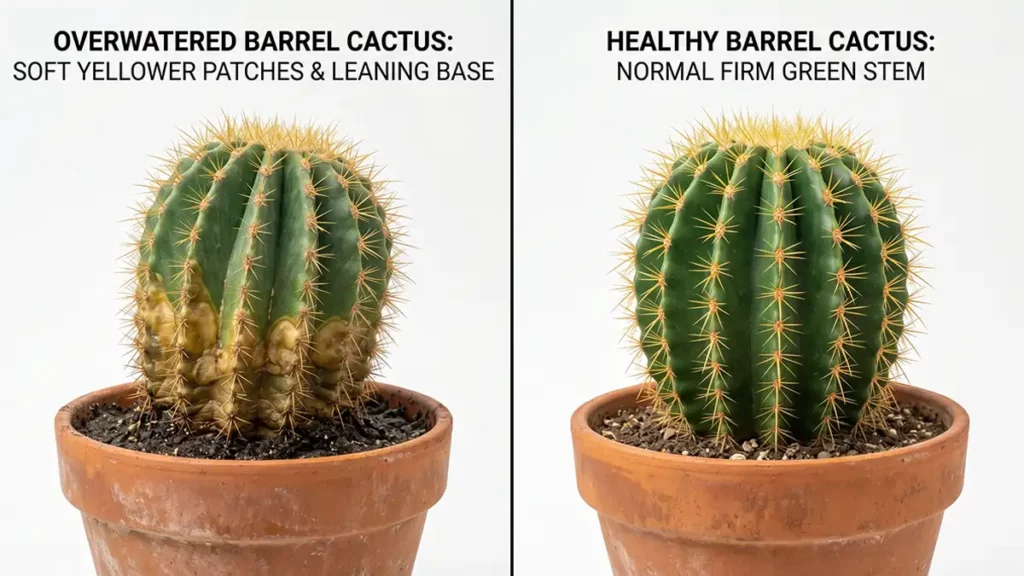
What Does an Overwatered Cactus Look Like?
Overwatering kills more cacti than drought. It does not require flooding: watering every week in a plastic pot in winter is enough.
Clemson University Extension states that root and stem rots in cacti usually result from soil that does not drain quickly or from overly frequent watering: noting that this is one of the most common causes of cactus failure indoors.
Signs of an overwatered cactus:
- Soft, mushy sections on the stem: the most definitive sign; healthy cactus stems are firm throughout
- Yellow or brown discoloration on the lower stem or base: soft to the touch
- The cactus leans or lists to one side as structural integrity fails at the base
- Stem shrinking despite wet soil: roots can no longer transport water due to rot
- Pale, washed-out color spreading across the stem
- Soil stays wet for more than 2 weeks after watering
- Roots brown, black, or mushy when inspected
Signs of an underwatered cactus:
- Stem appears slightly shrunken or wrinkled: the stored water is depleting
- Cactus feels lighter than usual: easily noticed by lifting the pot
- Skin of the stem begins to look slightly puckered
- Growth has completely stopped for more than one growing season
- The pot feels very light
This table serves one decision: is this overwatering or underwatering?
| Feature | Overwatered | Underwatered |
| Stem texture | Soft or mushy in spots | Slightly wrinkled or shrunken |
| Stem color | Yellow, brown, or pale | Normal color, possibly duller |
| Soil condition | Wet or damp | Bone dry throughout |
| Pot weight | Heavier than expected | Very light |
| Structural integrity | Leans, wobbles, or collapses | Still upright and firm |
| Correct action | Stop watering: check roots | Water deeply now |
The fastest test: press a firm fingertip against the stem away from the spines. A healthy cactus resists firm pressure. A soft spot that yields to light pressure means rot is present at that location.
How to save an overwatered cactus
Early stage: soft base, roots still partially viable:
- Remove from the pot: shake off all soil and discard it entirely
- Inspect the root system: healthy roots are white or tan and firm; rotted roots are brown, black, or mushy
- Inspect the stem base: cut upward into the stem until you reach completely firm, healthy green tissue
- Dust all cut surfaces with ground cinnamon
- Allow to air dry completely for 48 hours: do not rush this callous period
- Repot in fresh, dry cactus mix in a clean terracotta pot
- Do not water for 10–14 days after repotting
- Resume watering using the skewer test only
If the stem has rotted to the crown: recovery is very difficult. Check for any offsets or pups at the base that may still be viable. Remove these and treat as stem cuttings.
Use the plant problem diagnosis tool if symptoms are unclear or not responding to treatment.
For a full recovery protocol and symptom guide, see the overwatered vs underwatered plants guide.
Building a Cactus Watering Schedule
A cactus watering schedule should not be a fixed day of the month: it should be a checking calendar. The schedule determines when you test the soil; the soil decides whether you water.
How to build a checking schedule by group:
Desert cacti (standard indoor):
- Spring/summer: add a soil check to your diary every 10–14 days
- Fall/winter: schedule a check every 3–4 weeks
Mini cacti (pot under 10cm):
- Spring/summer: check every 7–10 days
- Fall/winter: check every 3 weeks
Jungle cacti (Christmas cactus, Easter cactus):
- Spring/summer: check every 7 days
- Fall/winter (pre-bloom): reduce to every 3–4 weeks to trigger bud formation
- Fall/winter (buds visible): resume checking weekly
On each checking day: run the skewer test to the bottom of the pot. Water only if the test confirms completely dry soil throughout. If any moisture remains, note it and check again in 5–7 days.
This system means you never water on autopilot. The schedule gives you the structure; the soil gives you the answer.
Use the free plant watering calculator to generate a personalized schedule that adjusts automatically for your cactus type, pot size, and season.
Best Pot and Soil for Cactus Watering
The pot and soil you use determine how quickly moisture leaves the root zone. Correct pot and soil choices make overwatering physically harder: they are as important as frequency.
This table serves one decision: which pot material to use for your cactus.
| Pot type | Drying speed | Recommendation | Risk |
| Terracotta (unglazed) | Fast: evaporates through walls | Best choice for all desert cacti | Dries faster: check sooner |
| Terracotta (glazed) | Medium | Good | Less drainage benefit than unglazed |
| Plastic | Slow | Use with caution | Significantly higher overwatering risk |
| Glazed ceramic | Slow | Acceptable with good drainage holes | Higher overwatering risk |
| No drainage hole | None | Never use | Root rot almost inevitable |
Terracotta is the strongest protection against overwatering. Moisture evaporates through the porous walls from all sides (not just the soil surface) drying the root zone 30–50% faster than the same cactus in a plastic pot. For a plant where overwatering is the primary cause of death, choosing terracotta is one of the most impactful decisions you can make.
Pot size: cacti generally prefer to be slightly pot-bound. An oversized pot holds more soil, which retains more moisture, which extends the wet period after each watering. Clemson University Extension notes that if the container is too large, the soil may stay moist and lead to rot. The pot should be only marginally larger than the root ball: repot up one size at a time.
Soil: standard potting mix holds moisture for days, far too long for a desert cactus. Use a dedicated cactus and succulent mix, or blend standard potting mix 50/50 with coarse horticultural grit or perlite. The mix should drain within minutes of watering and feel dry at depth within 1–2 weeks in summer.
Common Cactus Watering Mistakes
1. Watering on a fixed schedule
A calendar reminder for “every Sunday” ignores season, temperature, light level, and pot type: all of which change how fast the soil dries. Fixed schedules produce chronic overwatering in winter and spring.
Fix: schedule soil checks, use the skewer test to decide whether to water, not the date.
2. Using only the surface soil test
The top layer of cactus soil dries within 24–48 hours of watering. Checking only the surface and watering when it feels dry consistently overwaters the lower root zone.
Fix: use the full-depth skewer test every time. Only bone-dry results throughout justify watering.
3. Leaving water in the saucer
Even 20–30 minutes of standing water in the saucer re-saturates the lower root zone from below, undoing the drainage benefit.
Fix: empty the saucer within 15–20 minutes of every watering, every time.
4. Watering in low-light positions as frequently as sunny positions
A cactus in a dim corridor uses far less water than a cactus in direct sunlight. Watering both on the same schedule drowns the dim-position plant.
Fix: check the soil independently for each plant. Position determines frequency, not species name alone.
5. Not reducing watering in fall
Continuing a summer schedule into September and October is the most common route to winter cactus root rot. The transition happens gradually: growth slows from September, soil stays moist longer from October.
Fix: from late September, add 2 weeks to every checking interval. Reduce further in November.
6. Potting in standard potting mix
Standard mix holds moisture for 5–10 days, sometimes longer. Desert cacti need soil that drains in hours.
Fix: repot into cactus and succulent mix, or add 50% perlite or grit to standard mix. Do this once and every subsequent watering challenge becomes easier.
7. Treating a jungle cactus like a desert cactus
A Christmas cactus that never gets enough water will fail to flower, produce weak growth, and eventually decline. It is not a desert plant and should not be kept bone dry.
Fix: identify your cactus type. Jungle cacti need moisture levels between waterings that a desert cactus would find fatally wet.
Long-term Cactus Ownership: What to Expect
Desert cacti reward patience over years. Growth is slow by houseplant standards (a few centimeters per year for most indoor species) but a well-cared-for cactus can outlive many other houseplants with minimal intervention.
The first season: new cacti often have denser root systems than their pot suggests. Soil may dry faster than expected in the first few months. Use the skewer test weekly until you understand your specific plant’s drying rate.
After year one: most cacti stabilize into a predictable seasonal rhythm. You develop a feel for how heavy the pot should be at correct hydration, and the skewer test becomes a quick confirmation rather than a careful diagnostic.
Blooming: many desert cacti bloom reliably when given the correct winter rest, cool temperatures, minimal water, and good light. If your cactus has never bloomed, the most common cause is insufficient dryness or warmth during winter dormancy.
Offsetting: healthy cacti produce offsets, small pups around the base. These draw from the same root system and increase the total water demand slightly. A cactus producing multiple offsets may need the skewer test run slightly more frequently in summer.
Mineral salt buildup: over months and years of tap water use, salts accumulate in the soil. Brown needle tips and slow decline are the typical signs. Flush the soil every 6 months by running a large volume of plain water through it slowly (approximately four times the pot volume) and allowing it to drain completely.
Related Guides
- Aloe vera watering guide
- Lithops watering guide
- Echeveria watering guide
- Plant watering schedule generator
Frequently Asked Questions
How often should I water a cactus?
Desert cacti need watering every 14–21 days in spring and summer, and every 4–8 weeks in fall and winter. Jungle cacti (Christmas cactus, Easter cactus) need watering every 7–14 days in summer. Always use the full-depth skewer test to confirm bone-dry soil before every session.
How much water does a cactus need?
Water until it drains freely from the drainage holes: this confirms the full root zone has been reached. For a medium pot (12–15cm), this is approximately 150–200ml. Volume is a guide; drainage is the confirmation.
What is the best way to water a cactus?
Deep top watering: pour slowly over the soil (not the stem) until free drainage appears, drain for 10–15 minutes, empty the saucer immediately, and do not water again until the skewer test confirms completely dry soil throughout.
What does an overwatered cactus look like?
Soft or mushy spots on the stem, yellow or brown discoloration at the base, the cactus leaning or wobbling at the soil line, and pale washed-out color. Press the stem: healthy tissue is firm throughout; softness at any point signals rot.
How often to water cactus in winter?
Desert cacti need watering every 4–6 weeks in standard indoor conditions, or every 6–8 weeks in cool rooms. Some go the entire winter without water if kept cool and dry. Jungle cacti need every 3–4 weeks in pre-bloom fall to trigger flower bud formation.
How often to water cactus indoors?
Every 14–21 days in summer for most indoor desert cacti. Every 4–8 weeks in winter. Adjust for light level: bright sunny windows dry soil faster than dim positions.
How often to water mini cactus indoors?
Check every 7–10 days in summer using the skewer test: small pots dry faster than large ones. Water only when completely dry throughout. In winter, check every 3 weeks.
How often to water cactus outdoors?
Every 7–14 days for potted outdoor cacti in full sun in summer. Check more often in heat above 30°C / 86°F. Skip checks after significant rainfall.
Key Takeaways
- Desert cacti need watering every 14–21 days in summer and every 4–8 weeks in winter: the full-depth skewer test confirms readiness before every session.
- Jungle cacti (Christmas cactus, Easter cactus) are not desert plants: they need watering every 7–14 days in summer and require a distinct dry rest in fall to trigger flowering.
- The skewer test (pushed to the full depth of the pot) is the only reliable moisture check for cacti; the 2-inch finger test is not deep enough.
- Overwatering kills more cacti than drought; a slightly shrunken cactus is far safer than a softening one.
- Terracotta pots with cactus and succulent mix make overwatering physically harder: they are the single most effective structural protection against the leading cause of cactus death.
- Never leave a cactus standing in saucer water: empty within 15–20 minutes of every watering.
- Reduce all checking intervals by 50–100% from October as growth stops and soil stays wet far longer per session.
- Mini cacti in small pots dry faster than large specimens: check more frequently but water only when confirmed dry.
Desert cacti are among the longest-lived houseplants when given the right conditions: decades of trouble-free growth are realistic with the correct watering rhythm. Use the succulents and cacti watering guide for a broader overview of drought-tolerant plant care, or the free plant watering calculator to generate a personalized checking schedule for your specific cactus.
Sources
- Clemson University Cooperative Extension HGIC. Indoor Cacti. Indoor Cacti
- University of Minnesota Extension. Cacti and Succulents. Cacti and Succulents
- University of Maryland Extension. Watering Indoor Plants. Watering Indoor Plants
- NC State Extension. Gymnocalycium mihanovichii: Cactus Plant Profile. Cactus Plant Profile


